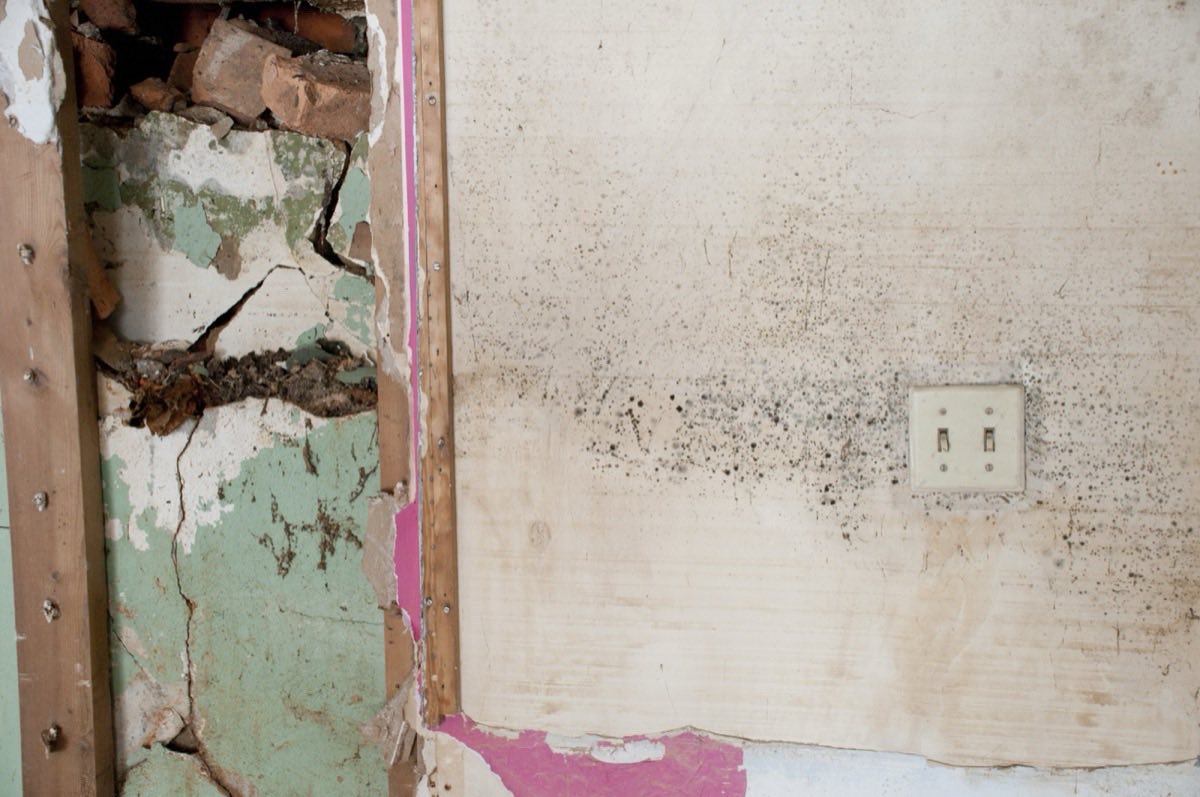
On tile or glass, a dark patch is usually a cleaning job. On drywall it is a different question, because drywall is the one common building material that is both food and sponge: the paper facing is cellulose, and the gypsum core holds water long after the surface feels dry.
That is why the same patch means more here than it would in a shower. The useful question on drywall is not just "mold or mildew" but how deep has it gone — on the paint, into the paper, or through into the cavity.
The Quick Answer
- Mildew on painted drywall is flat, dry and powdery, usually gray or greenish-gray, and speckled rather than solid. It sits on the paint film, wipes off, and does not come back once the room is drier. It is a humidity problem.
- Mold rooted in drywall is darker, may feel damp or slimy, has irregular spreading edges, and reappears after cleaning because it is feeding on the paper under the paint. It is a water problem.
The wipe test separates them in about thirty seconds. If it lifts off clean, you are almost certainly looking at mildew.
The Three Depths
Almost every drywall question resolves to which of these you have.
On the paint. Surface growth living on dust, skin oils and condensation, with the paint film still intact underneath. This is the good outcome. Clean it, improve ventilation, and it stays gone.
In the paper. The paint film has failed, or there was never much of one, and growth is consuming the paper facing. The stain will not clean out because it is not on the surface any more. The board is no longer salvageable in that area — porous material cannot be reliably disinfected, which is why remediation guidance is to remove rather than treat it.
Through to the cavity. Water has been in the wall. Whatever is on the face is the smaller half of the problem; the insulation, the back face of the board and possibly the framing are involved. This is the case that needs the wall opened.
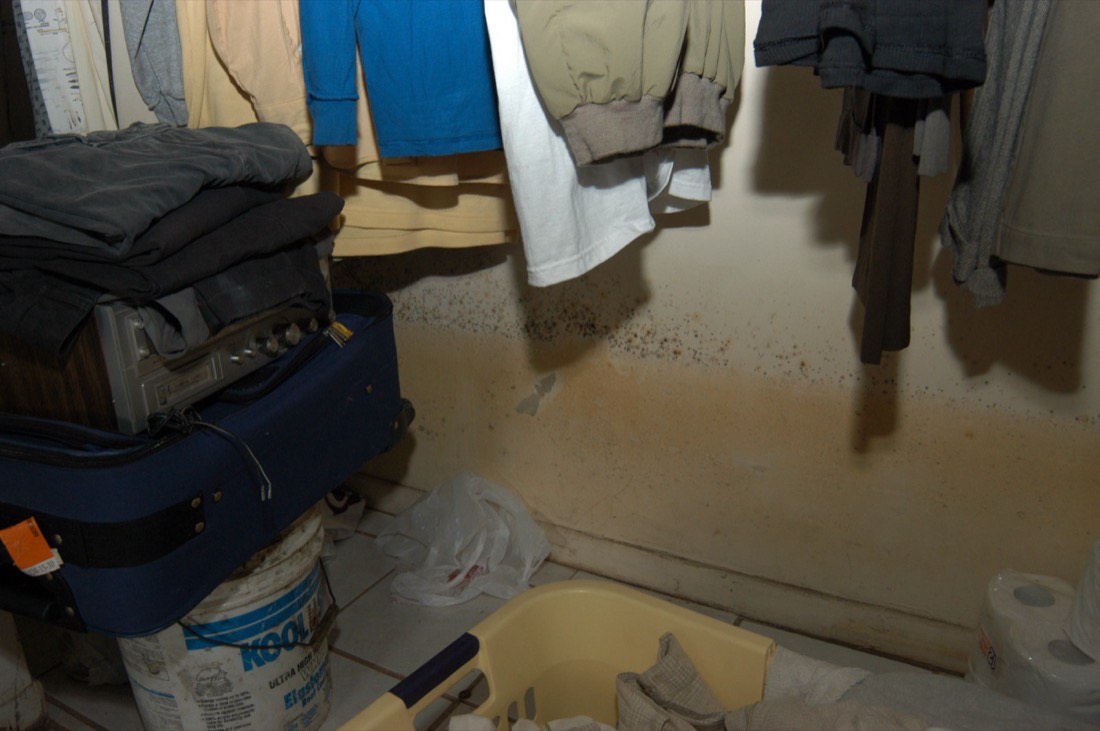
A flood waterline in West Palm Beach, Florida, after Hurricane Frances. Note that the tide line and the growth are two different marks: the stain records where the water stood, the speckling shows where it fed. FEMA photo by Mark Wolfe, public domain.
Stain or Growth? The Pattern Tells You
This is the single most useful distinction on a wall, and it is purely visual.
Water staining follows gravity. It forms smooth edges and horizontal tide lines, is usually tan, yellow or brown, and has a hard boundary where the water stopped. It records history — it tells you water was there, not that anything is living.
Growth radiates from moisture. Edges are irregular and blotchy, the color is gray-green to black, and it spreads outward in a way that ignores gravity. On a wall that flooded you will often see both, as in the photo above: a clean tide line where the water stood, and speckled growth in the damp band above it where the material stayed humid longest.
If what you have is only a smooth tan tide line with no texture and no speckling, you may not have a mold problem at all. Mold on walls vs water stains goes through that comparison in detail.
Where It Shows Up, and What Each Location Means
Location narrows the diagnosis faster than appearance does.
The bottom 12 inches, all the way round a room. This band is what wicks moisture up from a wet slab or a minor flood. Growth here is about groundwater or a past water event, not humidity.
Cold exterior corners, and behind furniture on exterior walls. The coldest surfaces in a room condense first. Diffuse gray speckling here is a ventilation and heating problem — the fix is airflow, not repair. This is the most commonly over-diagnosed pattern in the house.
Around and below windows. Condensation running off single-pane or metal-framed glass soaks the sill and the wall beneath it.
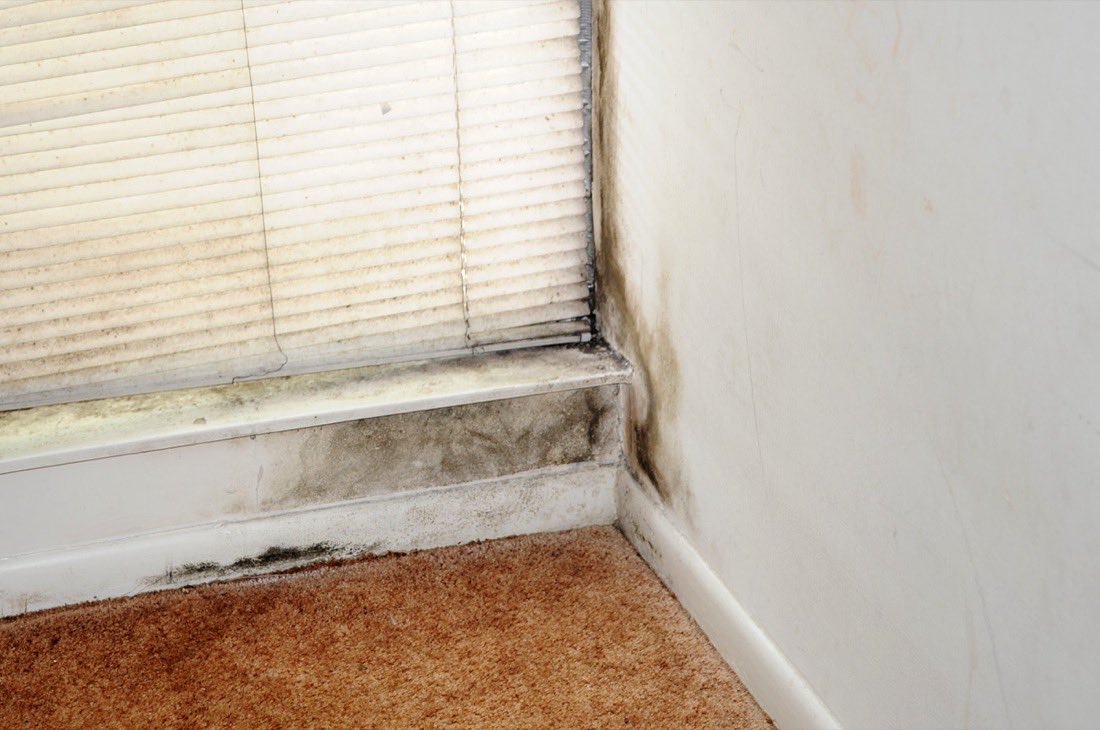
Condensation damage around a window: darker growth on the wall corner and baseboard, and a distinctly paler, greener growth along the sill itself. The two are not the same organism — which is exactly why color alone is a poor guide. FEMA photo, public domain.
Behind wallpaper. Wallpaper and vinyl coverings trap moisture against the board, so growth develops on the back with almost nothing visible on the front. The tells are bubbling, seams lifting, or a musty smell in a room that looks fine.
Low on a wall shared with a bathroom or kitchen, or anywhere near plumbing. Suspect a supply line or drain before humidity.
Ceilings behave differently enough to need their own diagnosis — water arrives from above rather than condensing in place. See black mold vs mildew on a ceiling.
Three Tests You Can Do Now
- The wipe test. Gloves and an N95. Wipe a small area with a damp cloth. Lifts clean → mildew on the paint film. Smears or stains → growth in the paper.
- The press test. Press the board firmly with a thumb. Firm resistance is good. Soft, spongy or slightly yielding means the gypsum has been wet long enough to lose integrity, and cleaning is no longer the question.
- The comparison reading. A pinless moisture meter costs about $25 and is the only one of the three that sees inside. Take a reading on the suspect area and then on the same wall a few feet away. It is the difference that matters, not the absolute number — a section reading noticeably higher than its neighbors means water is still present.
Why Painting Over It Fails
Worth stating plainly because it is the most common mistake on drywall: paint, including mold-blocking primer, does not fix mold in drywall.
Paint seals the surface. The colony is feeding on the paper facing beneath it and on the moisture behind that, and paint reaches neither. For a fortnight the wall looks repaired. Then the stain bleeds back through, usually larger, and you have lost the visible evidence of extent that you would have wanted for scoping the repair or making an insurance claim.
The same applies to bleach on drywall. Bleach is mostly water; on a porous surface it removes the color while delivering more moisture to the material underneath. It makes the wall look better and the problem slightly worse.
Cleaning vs Cutting Out
You can clean growth off painted drywall when the paint film is unbroken, the stain lifts, the board presses firm, and the moisture source is identified and fixed. Ventilate, wear gloves and an N95, and dry the area thoroughly afterwards.
The board comes out when the paper is stained through, the board is soft, growth keeps returning after cleaning, the affected area is larger than roughly 10 square feet, or there has been standing water in the wall. Standard practice is to cut back to the nearest studs and at least 12 inches beyond visible growth, because the colony extends past what you can see.
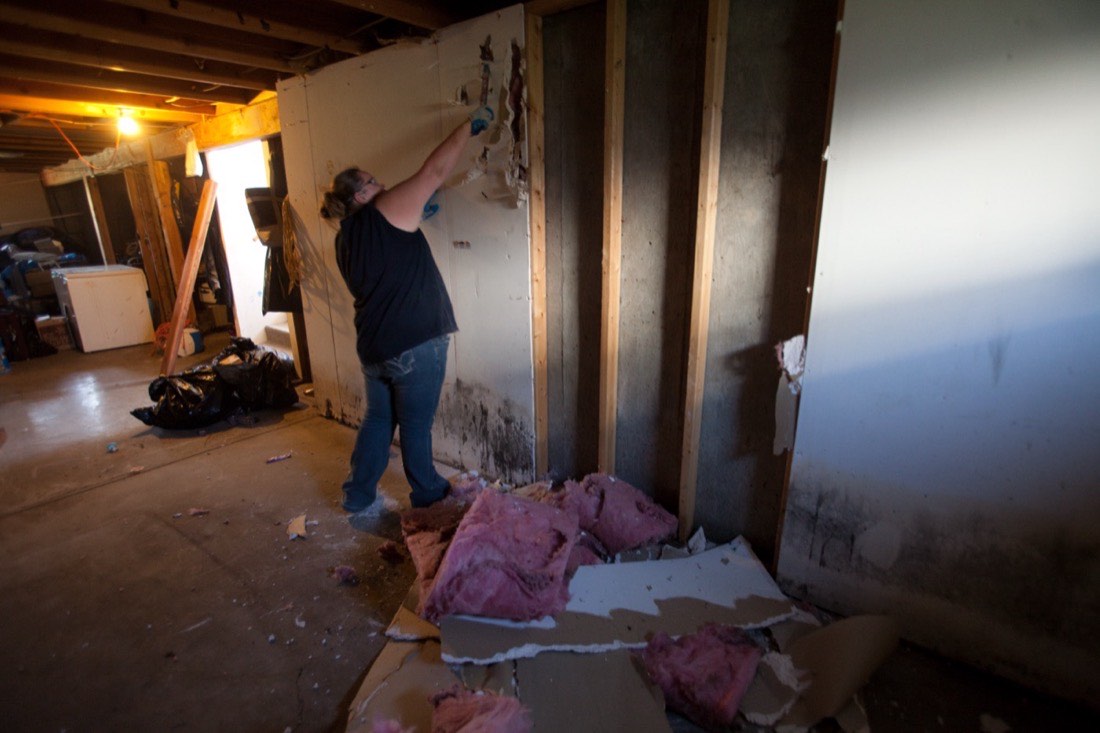
Drywall removal in a flooded basement on Rocky Boy's Indian Reservation, Montana. Note the growth concentrated along the bottom of the board — the wicking band described above — and that the insulation is coming out with it. FEMA photo, public domain.
How to remove mold from drywall covers the containment and cutting sequence step by step.
When to Stop and Call Someone
- The area is larger than about 10 square feet — the threshold both the EPA and CDC use
- The board is soft, or growth has reached insulation or framing
- It keeps returning after cleaning, which means the water source is still live
- There was standing water in the wall, or a leak that ran for more than a couple of days
- You can smell it but not find it — see the signs of mold behind drywall
- Occupants have symptoms that ease when they leave the house
The Honest Summary
On drywall, "is it mold or mildew?" is usually less important than "is the board still sound, and is the water still coming in?" Flat gray speckling on intact paint in a cold corner is a ventilation job. A spreading patch on a wall that presses soft is a construction job, whatever species it turns out to be.
If you cannot tell which one you are looking at, photograph it — close up for texture, wide for context and scale — before you clean anything. That photo is what lets you compare in a week, and it is what an insurer or a landlord will ask for. The full color, texture and behavior comparison is in black mold vs mildew, and the room-by-room checklist covers finding the water source that put it there.